
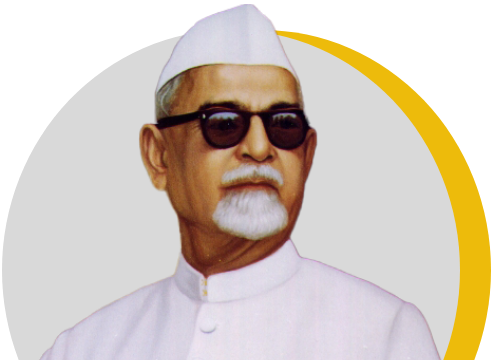
Dr. Zakir Husain
Dr. Zakir Husain (8 February 1897–3 May 1969) was an Indian educationist and statesman who served as the third President of India from 13 May 1967 until his death on 3 May 1969. He earlier served as Vice President of India (1962–1967) and held senior academic leadership roles at Jamia Millia Islamia and Aligarh Muslim University.
- Full name: Dr. Zakir Husain (also written as Zakir Husain Khan in some references) (President of India)
- Common name / short name: Zakir Husain; Dr. Zakir Husain (President of India)
- Category (Domain): Politics & Government
- Country: India
- Role/Office (primary): 3rd President of India (President of India)
- Current status: Deceased (Vice President of India)
- Party/Alliance: Not publicly confirmed in official bios; held non-partisan constitutional offices. (Some accounts note he was backed by the Indian National Congress for the 1962 Vice-Presidential election.) (Wikipedia)
- Date of birth: 8 February 1897 (Vice President of India)
- Constituency/Region: Not applicable (constitutional offices). Served as Governor of Bihar; born in Hyderabad. (Bihar Lok Bhavan)
- Place of birth: Hyderabad (then Hyderabad State; British India) (President of India)
- Date of death: 3 May 1969 (Vice President of India)
- Place of death: New Delhi, India (Encyclopedia Britannica)
- Education: M.A.; Ph.D. (Berlin); also connected with studies/work at Aligarh Muslim University in official bios; received multiple honorary D.Litt. (honoris causa). (Vice President of India)
- Profession/background before politics: Educationist, economist, academic administrator (notably university leadership roles). (President of India)
Overview
Dr. Zakir Husain is widely remembered as a senior education leader who later served in India’s highest constitutional offices. His public career combined academic administration, work linked to education planning, and leadership roles in government. He served as Governor of Bihar (1957–1962), Vice President (1962–1967), and then President (1967–1969).
Early life and education
He was born on 8 February 1897 in Hyderabad (then Hyderabad State; British India). Official biographical summaries list his education as an M.A. and a Ph.D. in Berlin, along with later honorary doctorates (D.Litt.).
Profession before politics
Before serving in constitutional offices, he was known primarily as an educationist, economist, and academic administrator. He held key university leadership posts, including long periods at Jamia Millia Islamia and Aligarh Muslim University.
Political career and key roles
Key positions held
- President of India: 13 May 1967 – 3 May 1969
- Vice President of India (ex-officio Chairman, Rajya Sabha): 13 May 1962 – 12 May 1967
- Governor of Bihar: 6 July 1957 – 11 May 1962
- Member, Rajya Sabha: 3 April 1952 – 6 July 1957
- Vice-Chancellor, Jamia Millia Islamia (Delhi): 1926 – 1948
- Vice-Chancellor, Aligarh Muslim University: 1948 – 1956
- President, Hindustani Talimi Sangh (Sevagram): 1938 – 1950
- Chairman, Basic National Education Committee (linked to “Wardha Scheme”): 1937
- Chairman, Central Board of Secondary Education (CBSE): 1957
Major elections and selection milestones
- 1962: Elected Vice President of India (term began 13 May 1962).
- 1967: Elected President of India (term began 13 May 1967).
Major initiatives and decisions
- 1937: Chaired the Basic National Education Committee linked to the Wardha scheme of basic education (often associated with craft-linked learning and foundational schooling).
- 1926–1948: Led and strengthened Jamia Millia Islamia as Vice-Chancellor; official bios also connect him with the institution’s early development.
- 1948–1956: Served as Vice-Chancellor of Aligarh Muslim University.
- 1962–1967: As Vice President, served as Chairman of the Rajya Sabha and guided parliamentary proceedings.
Books and Publications
Works listed in the official Vice President profile include:
- Shiksha (Hindi)
- Capitalism: an essay in understanding
- Urdu translations (listed): Plato’s Republic; Friedrich List’s National System of Economics; Edwin Cannan’s Elements of Economics
- Lectures/works listed: The Dynamic University; Educational Discourses (Urdu); Principles of Educational Reconstruction; Ethics and the State; Abbokhan Ki Bakri (Urdu)
Awards and honours
Public perception
Strengths commonly cited
He is often described as a respected scholar and public figure who helped present Indian philosophical traditions to international audiences. Official and encyclopedic sources emphasize his academic standing and his role in public life as Vice President and President.Criticisms and controversies
Academic critiques have focused mainly on interpretation, not personal misconduct. For example, the Internet Encyclopedia of Philosophy notes criticism of his broad “East vs West” framing, arguing that such categories can oversimplify complex traditions and reflect older ways of thinking in colonial-era scholarship.Legal cases
No verified criminal legal cases are highlighted in the official government profiles and standard encyclopedic summaries used here.Digital and Media
- Official website: Not applicable (historical public figure).
- Official social profiles: Not applicable.
- Government biography pages: Available on Indian government portals.
Table of Content
- Overview
- Early life and education
- Profession before politics
- Political career and key roles
- Key positions held
- Major elections and selection milestones
- Major initiatives and decisions
- Books and Publications
- Awards and honours
- Public perception
- Strengths commonly cited
- Criticisms and controversies
- Legal cases
- Digital and Media
Search Post
FAQs
Who was Dr. Sarvepalli Radhakrishnan?
He was an Indian philosopher and statesman who served as the second President of India (1962 -1967). He also served as India’s first Vice President (1952 -1962) and held major academic and diplomatic roles before entering top constitutional office.
When was Sarvepalli Radhakrishnan born?
He was born on 5 September 1888. Britannica lists his birthplace as Tiruttani, India (present-day Tamil Nadu).
When did Sarvepalli Radhakrishnan die?
He died in April 1975. Britannica gives 16 April 1975, while official government profiles list 17 April 1975.
What office is he most known for in Indian politics?
He is best known as the second President of India. His term is listed as 13 May 1962 to 13 May 1967 on the President of India profile.
Was he involved in party politics?
He is widely described as non-partisan and is commonly listed as “Independent.” His career is often framed as primarily academic and diplomatic before he entered constitutional roles.
What was Technology Vision 2020 and how is it linked to him?
A government document notes that Technology Vision 2020 (TIFAC) was released in 1996, with leadership credited under Dr. Kalam. The work is commonly referenced as a national-level planning exercise for science and technology priorities.
What was the 2006 “Office of Profit” bill episode?
Reports said he returned the bill for reconsideration and later gave assent after it was passed again. The discussion was framed as a constitutional and political debate, not a criminal allegation.
When and where did he die?
He died on 27 July 2015 in Shillong, India. This is stated in an official Embassy of India press release.