
Cheteshwar Pujara
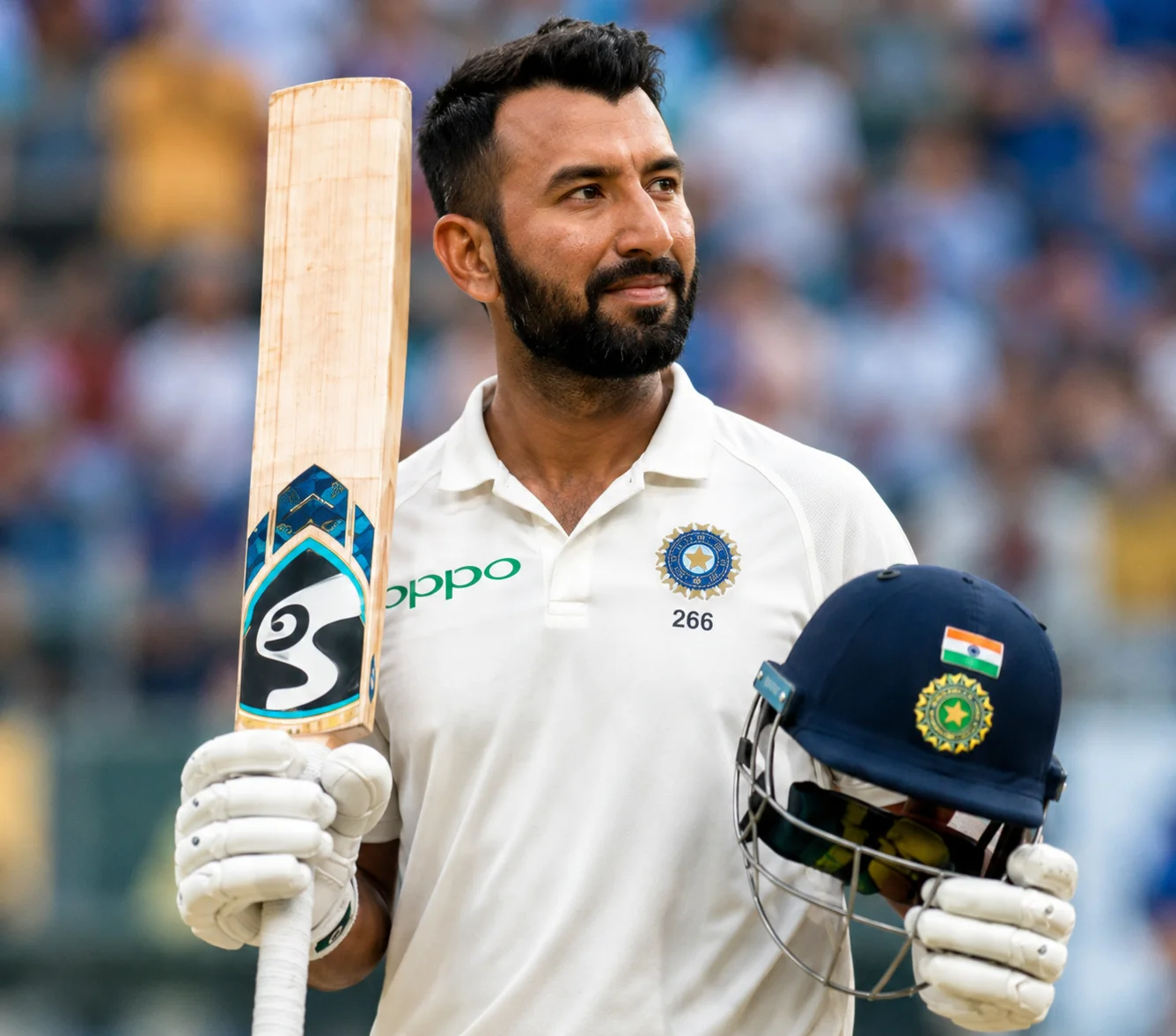
Cheteshwar Pujara is a former Indian international cricketer best known for his long and distinguished career as a Test-match batter. Born in Rajkot, Gujarat, on 25 January 1988, he represented India in 103 Tests and five ODIs before retiring from all forms of Indian cricket in August 2025. He finished his Test career with 7,195 runs, 19 centuries and 35 half-centuries at an average of 43.60.
Pujara became particularly associated with India’s No. 3 position and a batting style built around patience, concentration, sound defence and the ability to absorb pressure. His defining international achievements included a major contribution to India’s historic Test-series victory in Australia in 2018–19 and important performances during the 2020–21 Australian tour.
He retired on 24 August 2025, ending a professional playing career that had included international cricket, Saurashtra cricket, Indian domestic competitions and county cricket in England.
Quick Facts
Biography
Pujara emerged from Rajkot’s strong cricketing culture and developed into one of India’s most accomplished Test specialists of the 21st century.
His cricketing development began unusually early. His father, Arvind Pujara, was himself a first-class cricketer and became a major influence on his son’s technique and preparation. Pujara’s later career reflected that emphasis on discipline and long-form cricket.
He first gained major international attention in junior cricket. At the 2006 ICC Under-19 World Cup, Pujara scored 349 runs and was named Player of the Tournament, establishing himself as one of India’s leading young batting prospects.
His first-class career began in 2005–06 with Saurashtra. Over the following years he became one of India’s most prolific domestic batters before making his Test debut against Australia in Bengaluru in October 2010.
Early Life
Pujara was born in Rajkot, then part of the Saurashtra cricketing region, on 25 January 1988. His father Arvind played Ranji Trophy cricket and later coached and guided him. His uncle, Bipin Pujara, also played Ranji Trophy cricket.
According to later accounts from Pujara himself and his father, cricket became part of his life from a very young age. His father placed strong emphasis on technique and patience, qualities that later became central to Pujara’s batting identity.
Pujara’s mother, Reena, was also an important influence on his upbringing. She died of cancer when he was 17. His father later described her as a major influence on Pujara’s character and values.
Education
A detailed educational history—including a reliably verified list of schools, university qualifications and degrees—is not sufficiently established by the strongest sources reviewed for this profile.
Rather than repeat commonly circulated but insufficiently sourced claims, those details have been omitted.
Cricket Career
Early Domestic Career
Pujara made his first-class debut for Saurashtra in 2005. BCCI described him as being known in Indian domestic cricket for scoring large hundreds from the beginning of his first-class career.
His domestic performances were particularly important because Saurashtra was not traditionally one of India’s dominant Ranji Trophy teams. Pujara nevertheless remained closely associated with the state and continued playing domestic cricket throughout his career.
His overall first-class record, according to Derbyshire’s historical player archive, stands at 278 matches, 21,301 runs, 66 centuries and 81 fifties, with a highest score of 352.
Under-19 Cricket
Pujara’s breakthrough at youth level came at the 2006 ICC Under-19 World Cup in Sri Lanka.
He scored:
- 349 runs
- Average: 116.33
- Highest score: 129*
- Player of the Tournament
- Leading run-scorer of the tournament
ICC identifies him as the tournament’s leading run-scorer and Player of the Tournament.
India eventually lost the final to Pakistan, but Pujara’s tournament established him as one of the leading young batters in international junior cricket.
Test Debut and Early International Career
Pujara made his Test debut against Australia in Bengaluru in October 2010.
He scored 72 in the second innings of that match, helping India chase a challenging target and win the Test.
His early international career was interrupted by a serious knee injury. BCCI reported that he spent much of 2011 undergoing rehabilitation before returning to the Test side.
The setback did not prevent him from eventually establishing himself as India’s regular No. 3.
Breakthrough in 2012–13
The 2012–13 period transformed Pujara into an established international batter.
Against England in Ahmedabad in November 2012, he scored 206*, his first Test double century. BCCI records the innings as the 19th Test double-century by an Indian batter at the time.
A few months later, against Australia in Hyderabad, Pujara scored 204 after beginning the innings with 162*. It was his second Test double century in only his 11th Test.
These performances helped establish him as the successor to Rahul Dravid’s long-held No. 3 role in India’s Test batting order.
Overseas Development
Pujara’s career was not limited to Indian conditions.
He specifically regarded overseas performance as an important measure of his development.
He subsequently scored Test centuries in India, Australia, Bangladesh, England, South Africa and Sri Lanka, demonstrating that his method was effective across very different conditions.
He also gained experience in English county cricket, representing teams including Derbyshire, Yorkshire, Nottinghamshire and Sussex.
Major Achievements
1. 2006 ICC Under-19 World Cup Player of the Tournament
Pujara was the leading run-scorer at the 2006 Under-19 World Cup with 349 runs and was named Player of the Tournament.
2. 7,195 Test Runs for India
He finished his Test career with 7,195 runs, making him India’s eighth-highest Test run-scorer at the time of his retirement.
3. 19 Test Centuries
Pujara finished with 19 Test centuries, including multiple double centuries.
4. 2018–19 Border-Gavaskar Trophy
Pujara was central to India’s historic first Test-series victory in Australia. He scored 521 runs across the series and faced more than 1,200 deliveries. His performances earned him the Player of the Series award.
5. 2021 Gabba Test
During India’s historic Brisbane victory in January 2021, Pujara made 56 in the second innings while repeatedly absorbing blows from Australia’s fast bowlers. His innings became emblematic of his willingness to withstand physical pressure for the team’s cause.
6. 525-ball innings in Ranchi
Against Australia in 2017, Pujara scored 202 in Ranchi and faced 525 deliveries, an Indian Test record for balls faced in an innings at the time. BCCI records the innings as lasting 672 minutes.
Major Works
For a sports personality, the relevant “works” are primarily playing achievements rather than publications or creative works.
Major Test Innings
- 206* vs England, Ahmedabad, 2012
- 204 vs Australia, Hyderabad, 2013
- 202 vs Australia, Ranchi, 2017
- 145* vs Sri Lanka, Colombo, 2015
- 92 vs Australia, Bengaluru, 2017
- 77 vs Australia, Sydney, 2021
- 56 vs Australia, Brisbane, 2021
These performances are highlighted across BCCI and ICC retrospectives.
County Cricket
Pujara also built a significant county-cricket record in England. Sussex reported that, through his first 18 County Championship appearances for the club, he had scored 1,863 runs at 64.24, including eight centuries and three fifties. His Sussex-best at that point was 231 against Derbyshire in 2022.
Awards & Honors
ICC confirms his 2006 Under-19 Player of the Tournament award and his 2013 Emerging Cricketer award. BCCI’s annual report also confirms his 2013 ICC award and selection in the ICC Test Team of the Year.
The 2018–19 Player of the Series recognition is documented in contemporary reporting and retrospective coverage of India’s Australian series.
Career Timeline
Born in Rajkot, Saurashtra, India.
Made his first-class debut for Saurashtra.
Led the ICC Under-19 World Cup run-scoring charts with 349 runs and was named Player of the Tournament.
Made Test debut for India against Australia in Bengaluru.
Spent much of the year recovering from knee injury and rehabilitation.
Scored his maiden Test double century, 206* against England in Ahmedabad.
Scored 204 against Australia in Hyderabad; won ICC Emerging Cricketer of the Year.
Continued as a major Test batter while also gaining extensive county-cricket experience in England.
Scored 202 against Australia in Ranchi after facing 525 deliveries.
Scored 521 runs in India's historic Test-series victory in Australia and was Player of the Series.
Played important fighting innings in Sydney and Brisbane during India's successful Australian tour.
Continued his county career with Sussex while remaining active in Indian domestic cricket.
Played his final Test for India in the World Test Championship Final against Australia at The Oval.
Continued first-class cricket for Saurashtra. His overall first-class record through 2024–25 stands at 21,301 runs and 66 centuries.
Announced retirement from all forms of Indian cricket.
Continued appearing in cricket media and analysis after retirement.
Businesses & Organizations
Saurashtra Cricket
Saurashtra was the central domestic team of his career. He remained associated with the side from his first-class debut in 2005 through the 2024–25 season.
India
He represented the Indian men’s national team from 2010 to 2023, playing 103 Tests and five ODIs.
County Cricket
His major English county affiliations included:
- Derbyshire
- Yorkshire
- Nottinghamshire
- Sussex
Indian Premier League
His documented IPL teams included:
- Kolkata Knight Riders
- Royal Challengers Bangalore
- Kings XI Punjab
- Chennai Super Kings
His IPL opportunities were limited compared with his Test career.
There is no sufficiently reliable evidence in the sources reviewed to classify Pujara as the founder or owner of a major independent business.
Personal Life
Pujara married Puja Pabari in February 2013 in Rajkot. Contemporary reporting identified Pabari as being from Gujarat’s Jamnagar district and as a management graduate.
The couple have a daughter, Aditi, who was born in February 2018. Pujara publicly acknowledged the birth at the time, and later interviews have discussed his relationship with his daughter and family life.
Pujara has repeatedly described his family as an important source of support during his cricket career. In his retirement statement, he specifically thanked his parents, wife Puja, daughter Aditi and extended family for their sacrifices and support.
His mother, Reena, died from cancer when he was 17. His father Arvind has spoken extensively about the influence she had on Pujara’s character and approach to life.
Religion, Beliefs & Spiritual Tradition
A definitive religious identity is not assigned here because the strongest sources reviewed do not provide an appropriate, direct basis for doing so.
There is, however, reliable reporting about Pujara’s family spiritual background. His father described his late wife Reena as deeply spiritual and discussed her emphasis on puja, self-discipline and teachings associated with the Bhagavad Gita. Pujara’s 2025 retirement statement also referred to the guidance of his “spiritual guru.”
Philanthropy & Social Impact
No major independent philanthropic foundation, large-scale charitable organization or sustained humanitarian initiative could be established with sufficient confidence from the high-quality sources reviewed.
Accordingly, no specific philanthropic achievement is attributed to Pujara in this profile.
Controversies & Criticism
Pujara’s career attracted criticism primarily around batting tempo, strike rate and his suitability for limited-overs cricket, rather than major personal controversies.
He himself acknowledged that an image had developed around him as an extremely defensive batter, while explaining in a 2012 BCCI interview that his domestic strike rate could be substantially more aggressive than that perception suggested.
These are career debates rather than established misconduct or personal controversies.
Legal Issues
No significant legal case involving Cheteshwar Pujara was identified in the reliable sources reviewed that warrants inclusion in a general biographical profile.
Influence & Legacy
Pujara’s principal legacy is his role in India’s modern Test batting.
He became the team’s long-term No. 3 after the retirement of Rahul Dravid and developed a reputation for occupying the crease for long periods, particularly when India needed to withstand high-quality bowling.
His importance was especially visible during India’s victories in Australia. In 2018–19, his 521 runs helped India win a Test series in Australia for the first time. In 2020–21, his resistance in Sydney and Brisbane contributed to another historic series victory.
His 525-ball innings in Ranchi in 2017 also became a powerful illustration of his batting philosophy: survival, concentration and gradual accumulation rather than constant attacking.
At retirement, the BCCI described him as a batter whose resilience, patience and commitment to Test cricket had defined an important period of Indian cricket.
Related People
Family relationships are supported by reporting and interviews; professional relationships are included only where the cricketing association is well documented.
Countries & Places Associated With
India
- Rajkot — birthplace and long-term cricketing base.
- Saurashtra — domestic cricket association.
- Bengaluru — Test debut.
- Ahmedabad — major early Test double century.
- Hyderabad — 204 against Australia in 2013.
- Ranchi — famous 202 against Australia in 2017.
England
Pujara played county cricket for several English counties, including Yorkshire, Derbyshire, Nottinghamshire and Sussex.
Australia
Australia became one of the most significant countries in Pujara’s international career because of his performances in the 2018–19 and 2020–21 Test series.
Languages
Reliable sources reviewed for this profile do not establish a sufficiently authoritative list of Pujara’s native, spoken or working languages.
Because language ability should not be inferred from birthplace or nationality, no unsupported language list is provided.
Frequently Asked Questions
Who is Cheteshwar Pujara?
Cheteshwar Pujara is a former Indian international cricketer best known for his Test batting. He represented India in 103 Tests and finished with 7,195 Test runs.
When was Cheteshwar Pujara born?
He was born on 25 January 1988 in Rajkot, Saurashtra, India.
What is Cheteshwar Pujara famous for?
He is best known for his Test batting, particularly his concentration, defensive technique and ability to play long innings under pressure.
How many Tests did Cheteshwar Pujara play?
He played 103 Tests for India.
How many Test runs did Pujara score?
He scored 7,195 Test runs, including 19 centuries and 35 fifties.
What was Pujara's highest Test score?
His highest Test score was 206 not out, scored against England in Ahmedabad in 2012.
What was Pujara's role in India's 2018–19 Australia series?
He scored 521 runs and was named Player of the Series as India won a Test series in Australia for the first time.
Did Pujara play in the IPL?
Yes. He represented franchises including Kolkata Knight Riders, Royal Challengers Bangalore, Kings XI Punjab and Chennai Super Kings, although his IPL career was much less prominent than his Test career.
When did Cheteshwar Pujara retire?
He announced his retirement from all forms of Indian cricket on 24 August 2025.
When did Pujara play his last Test?
His final Test was the 2023 World Test Championship Final against Australia at The Oval.
Who is Cheteshwar Pujara's wife?
His wife is Puja Pabari, whom he married in February 2013.
Does Cheteshwar Pujara have children?
Yes. Pujara and his wife have a daughter named Aditi.
What is Pujara doing after retirement?
After retiring as a player, Pujara has remained associated with cricket through media and analytical work. Recent reporting also indicates that he has continued providing commentary and cricket analysis.
Key Source Set
- BCCI — Pujara retirement/career tribute — Primary source for his Indian career statistics and retirement recognition.
- ICC — Pujara retirement profile — International governing-body source for retirement, career statistics and major achievements.
- ICC — 2006 Under-19 World Cup profile — Confirms Player of the Tournament and 349 runs.
- ICC — 2013 Emerging Cricketer award — Confirms his ICC award.
- Derbyshire Cricket Archive — Cheteshwar Pujara player record — Detailed career/team and statistical record.
- Sussex Cricket — 2024 signing and county record — Primary Sussex source for his county career.
- BBC Sport — Pujara and Sussex — Independent confirmation of his county career.
- Reuters — Pujara retirement report — Independent confirmation of retirement and 2018–19 Australia statistics.
- Indian Express — Arvind Pujara interview — Important family/background source.
- Indian Express — Pujara family/interview material — Original interview material concerning his family and career philosophy.
Editorial conclusion: Cheteshwar Pujara’s most defensible biographical identity is that of a Rajkot-born Indian Test specialist whose career was defined by endurance, technical discipline and resistance under pressure, culminating in 103 Tests and 7,195 runs. His strongest historical significance comes from his contribution to India’s transformation into a successful overseas Test side, especially in Australia, rather than from his comparatively limited white-ball career.